
Built on international engineering standards
Every calculation is traceable back to a published standard — no black boxes, no proprietary approximations.
ISO 6336
VDI 2736
DIN 3990 (coming soon)
DIN 3960/ISO 21771
Two ways to design a gear pair.
Whether you have a specific design in mind or only a load envelope, Zenomiq meets you where you are.
Manual mode
You define every parameter.
Set teeth count, module, material, applied torque and helix angle. Zenomiq computes geometry, K-factors and safety factors in ~100 ms. Tweak, recalculate, iterate.
- Full control over each input
- Switchable K-factor method (B / C / manual)
- Live cross-section render
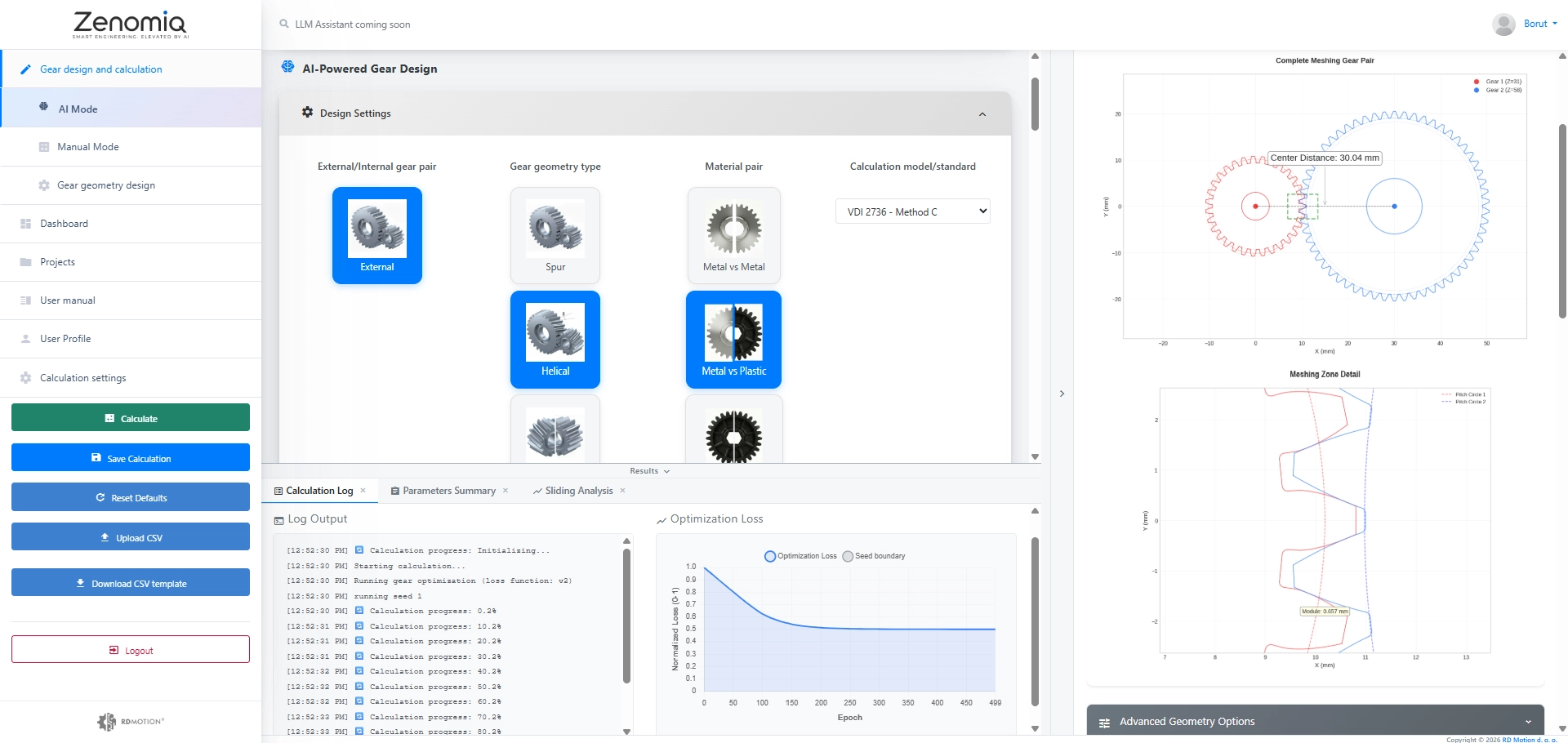
AI mode
Specify the requirement. We find the design.
Give Zenomiq your input specs. A PINN optimizer (PyTorch autograd) explores the feasible space and returns a standard-compliant manufacturing-ready gear pair design.
- Variable parameters with min / max bounds
- Multi-target optimization with weights
- Streamed intermediate results (SSE)
How it works
From parameters to a verified, standards-compliant gear pair.
Define your inputs
Enter parameters by hand or upload an input CSV. Choose Manual or AI mode and select the relevant standard.
Engineering pipeline runs
Constant + optimizable parameters → iterative geometry generation → material + lubricant selection → gear rating calculations → viable solution confirmation.
Get a verified design
Safety factors, gear parameters report, cross-section render, and optional manufacturing-ready 3D CAD geometry generated.
Everything a gear engineer needs.
Specialised tools that replace the spreadsheet sprawl and hand calculations — without giving up the audit trail.
Bending & pitting safety factors
Root stress and flank stress safety factors computed per ISO 6336, with full K-factor breakdown.
AI optimizer
Bayesian optimization with gradient descent, weighted multi-objective targets, streamed intermediate results.
3D-accurate geometry
Generate involute tooth profiles via FreeCAD — export the actual surfaces, not just a schematic.
CSV import / export
Drop in a parameter sheet, get results back. Bounds are auto-clamped to the configured valid range.
Live calculation stream
Server-Sent Events stream optimizer iterations to the UI in real time — watch the design converge.
Traceable to the standard
Every formula maps to a specific clause in ISO 6336, VDI 2736 or DIN 3990. No hidden coefficients.
Designed for engineers who ship hardware.
From a single test rig to a fleet of industrial drives, Zenomiq replaces error-prone hand calculations with verified, repeatable results.
Frequently asked questions
Everything you might want to know before kicking the tires.
Which standards does Zenomiq implement?+
ISO 6336:2019 (Method B) for steel gears and VDI 2736 (Method C and modified Method B) for plastic gears, with DIN 3990 on the roadmap. Base geometry follows DIN 3960 / ISO 21771, with ISO 53 rack profiles.
What is the difference between Manual mode and AI mode?+
In Manual mode you define every parameter — number of teeth, module, material, torque — and Zenomiq runs a single-pass calculation. In AI mode you mark some parameters as variables with bounds and define optimization targets; an AI optimizer finds a design that meets your requirements.
Can Zenomiq handle helical gears?+
Yes. External spur and helical gear pairs are supported, with profile shift and tip diameter modifications. Internal gear pairs are on the roadmap.
Does Zenomiq generate 3D geometry?+
Yes — Zenomiq can generate 3D-accurate involute tooth geometry via FreeCAD under the hood, so you get the actual tooth surfaces rather than a schematic representation.
Is the math auditable?+
Every formula maps to a specific clause of a published standard. There are no hidden coefficients or proprietary approximations — if a reviewer asks where a number came from, Zenomiq can show them.